Bleeding esophageal varices
Liver cirrhosis - varices; Cryptogenic chronic liver disease - varices; End-stage liver disease - varices; Alcoholic liver disease - varices; NASH varices; Alcoholic hepatitis - varices; Metabolic dysfunction-associated steatohepatitis (MASH) varices
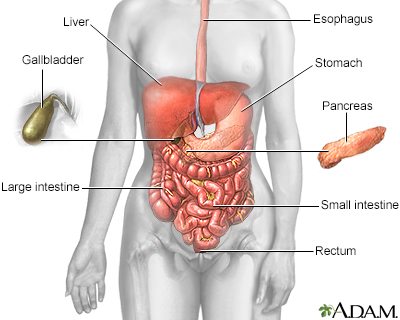
The esophagus (food pipe) is the tube that connects your throat to your stomach. Varices are enlarged veins that may be found in the esophagus in people with cirrhosis of the liver. These veins may rupture and bleed.
Images
I Would Like to Learn About:
Causes
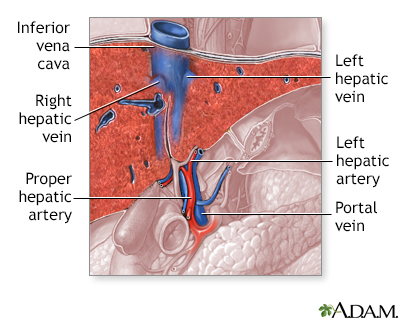
Scarring (cirrhosis) of the liver is the most common cause of esophageal varices. This scarring cuts down on blood flowing through the liver. As a result, more blood flows through the veins of the esophagus.
The extra blood flow causes the veins in the esophagus to balloon outward forming esophageal varices. Heavy bleeding can occur if the varices tear.
Any type of long-term (chronic) liver disease can cause esophageal varices.
Varices can also occur in the upper part of the stomach. These are called gastric varices.
Symptoms
People with chronic liver disease and esophageal varices may have no symptoms.
If there is only a small amount of bleeding, the only symptom may be dark or black streaks in the stools.
If larger amounts of bleeding occur, symptoms may include:
- Black, tarry stools
- Bloody stools
- Lightheadedness
- Paleness
- Symptoms of chronic liver disease
- Vomiting blood
Exams and Tests
Your health care provider will do a physical exam which may show:
- Bloody or black stool (in a rectal exam)
- Low blood pressure
- Rapid heart rate
- Signs of chronic liver disease or cirrhosis
Tests to find the source of the bleeding and check if there is active bleeding include:
- EGD or upper endoscopy, which involves the use of a camera on a flexible tube to examine the esophagus and stomach.
- Insertion of a tube through the nose into the stomach (nasogastric tube) to look for signs of bleeding.
Some providers suggest EGD for people who are newly diagnosed with mild to moderate cirrhosis. This test screens for esophageal varices and treats them before there is bleeding.
Treatment
The goal of treatment is to stop acute bleeding as soon as possible. Bleeding must be controlled quickly to prevent shock and death.
If massive bleeding occurs, a person may need to be put on a ventilator to protect their airway and prevent blood from going down into the lungs.
To stop the bleeding, the provider may pass an endoscope (tube with a small light at the end) into the esophagus:
- A clotting medicine may be injected into the varices.
- A rubber band may be placed around the bleeding varices (called banding or band ligation). Banding is the most common endoscopic treatment for esophageal varices.
Other treatments to stop the bleeding:
- A medicine to tighten blood vessels may be given through a vein. Examples include octreotide or vasopressin.
- Rarely, a tube may be inserted through the nose into the stomach and inflated with air. This produces pressure against the bleeding veins (balloon tamponade).
Once the bleeding is stopped, other varices can be treated with medicines and medical procedures to prevent future bleeding. These include:
- Drugs called beta blockers, such as propranolol, nadolol, and carvedilol that reduce portal vein pressure and the risk of bleeding.
- A rubber band can be placed around the varices during an EGD procedure. Also, some medicines can be injected into the varices during EGD to cause them to clot.
- Transjugular intrahepatic portosystemic shunt (TIPS). This is a procedure to create new connections between two blood vessels in your liver. This can decrease pressure in the varices and prevent bleeding episodes from happening again.
In rare cases, emergency surgery may be used to treat people if other treatment fails. Portacaval shunts or surgery to reduce the pressure in the esophageal varices are treatment options, but these procedures are risky.
People with bleeding varices from liver disease may need more treatment for their liver disease, including a liver transplant.
Outlook (Prognosis)
Bleeding often comes back with or without treatment.
Bleeding esophageal varices are a serious complication of liver disease and have a poor outcome.
Placement of a shunt can lead to an increase of metabolic toxins gong to the brain. This can lead to mental status changes.
Possible Complications
Future problems caused by varices may include:
- Narrowing or stricture of the esophagus due to scarring after a procedure
- Return of bleeding after treatment
When to Contact a Medical Professional
Contact your provider or go to an emergency room if you vomit blood or have black tarry stools.
Prevention
Treating the causes of liver disease may prevent bleeding. Liver transplantation should be considered for some people.
Related Information
Liver diseaseBlack or tarry stools
Shock
Hypovolemic shock
Esophageal stricture - benign
Cirrhosis - discharge
References
Garcia-Tsao G. Cirrhosis and its sequelae. In: Goldman L, Cooney KA, eds. Goldman-Cecil Medicine. 27th ed. Philadelphia, PA: Elsevier; 2024:chap 139.
Savides TJ, Jensen DM. Gastrointestinal bleeding. In: Feldman M, Friedman LS, Brandt LJ, eds. Sleisenger and Fordtran's Gastrointestinal and Liver Disease: Pathophysiology/Diagnosis/Management. 11th ed. Philadelphia, PA: Elsevier; 2021:chap 20.
Shah VH, Kamath PS. Portal hypertension and variceal bleeding. In: Feldman M, Friedman LS, Brandt LJ, eds. Sleisenger and Fordtran's Gastrointestinal and Liver Disease: Pathophysiology/Diagnosis/Management. 11th ed. Philadelphia, PA: Elsevier; 2021:chap 92.
BACK TO TOPReview Date: 12/31/2023
Reviewed By: Jenifer K. Lehrer, MD, Department of Gastroenterology, Aria - Jefferson Health Torresdale, Jefferson Digestive Diseases Network, Philadelphia, PA. Review provided by VeriMed Healthcare Network. Also reviewed by David C. Dugdale, MD, Medical Director, Brenda Conaway, Editorial Director, and the A.D.A.M. Editorial team.

Health Content Provider
06/01/2025
|
A.D.A.M., Inc. is accredited by URAC, for Health Content Provider (www.urac.org). URAC's accreditation program is an independent audit to verify that A.D.A.M. follows rigorous standards of quality and accountability. A.D.A.M. is among the first to achieve this important distinction for online health information and services. Learn more about A.D.A.M.'s editorial policy, editorial process and privacy policy. A.D.A.M. is also a founding member of Hi-Ethics. This site complied with the HONcode standard for trustworthy health information from 1995 to 2022, after which HON (Health On the Net, a not-for-profit organization that promoted transparent and reliable health information online) was discontinued. |
The information provided herein should not be used during any medical emergency or for the diagnosis or treatment of any medical condition. A licensed medical professional should be consulted for diagnosis and treatment of any and all medical conditions. Links to other sites are provided for information only -- they do not constitute endorsements of those other sites. © 1997- 2025 A.D.A.M., a business unit of Ebix, Inc. Any duplication or distribution of the information contained herein is strictly prohibited.
 All rights reserved.